
Insights
Why Business Energy Quotes Break Down
And the Truth You Only Discover on the Bill
Published Last updated
6 min readYou open the first bill and the number is wrong. Not dramatically wrong, but wrong enough that you notice. Sometimes a supplier misreads a meter or carries a standing charge across from an old contract. But most of the time, the issue lies elsewhere. The bill has not wandered from the quote. It has replaced an early sketch with a sharper image.
A quote begins as a guess
Every business energy quote begins with an estimated annual consumption (EAC) figure. It looks precise. It feels authoritative. It is presented as though it captures a stable picture of your organisation. Yet, in most cases, that neat number is stitched together from scraps of information. A single month’s consumption, a quiet season, a busy one, anything that can be multiplied by twelve and treated as a year.
This would be harmless if businesses used energy like metronomes. But patterns move. Winter stretches demand, summer relaxes it, weekends look nothing like weekdays, and operations follow rhythms no algorithm can infer from one datapoint. Two organisations with identical annual usage can impose completely different pressures on the system, simply because they use energy at different times of day.
Graphic 1 reveals the quiet distortion inside this approach.
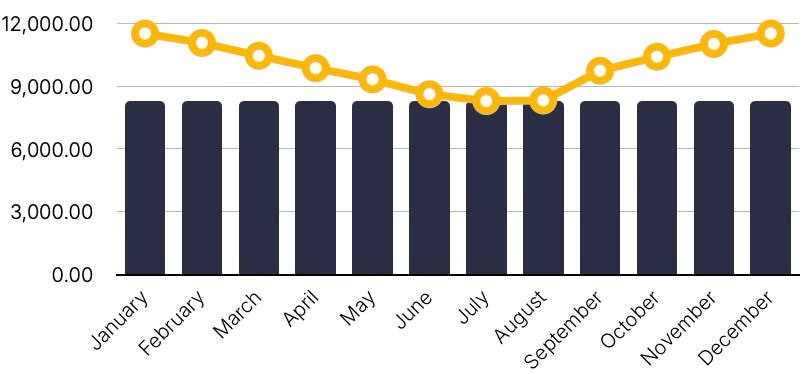
“One Month Stretched Into a Year” places a flat, extrapolated number against the real cadence of the months. A summer bill, multiplied by twelve, shrinks your year into its lightest footprint. A winter bill expands it into something heavier than your true pattern. The line the system uses is perfectly straight. The line you actually live traces a curve. Once seen side by side, the gap is impossible to ignore.
The quote cannot see any of this. Instead, it produces a smooth, generic version of you, a soft outline of the real shape. That same seasonal rhythm, missing from the quote, explains why solar aligns with some months more naturally than others.
And it is from that outline that every subsequent number is built.
Shape is the first thing lost
To turn the outline into a price, suppliers rely on a set of simplifications. They have to. The quoting process is built for speed and comparison, not fidelity. What you receive is not a view of your real behaviour. It is a reconstruction assembled from averages and templates that stand in for the truth.
The most significant substitution is shape.
Without half-hourly data, the system cannot see when you use energy, only how much. Timing disappears. Pattern disappears. What remains is an industry load profile, a standardised curve that replaces the rhythm of your operations with a generic impression.
Graphic 2 shows how much can be lost in that swap.
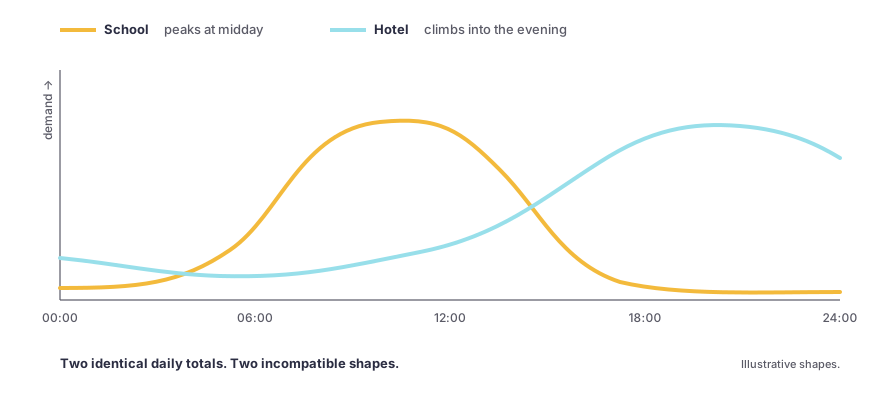
Two organisations, a school and a hotel, each consume the same amount of energy across the day. The total kilowatt-hours match. But the curves could not be more different. The school rises sharply in the morning, peaks at midday, then falls away before the evening. The hotel moves quietly at first, then climbs into the late afternoon and carries on into the night. Two identical totals, two incompatible shapes.
Yet the quoting process treats them as though they are interchangeable.
The system buys electricity in thirty-minute windows, not in daily bundles, and the cost of serving you depends on when you create demand within those windows. A school driving its usage into the daytime sun and a hotel placing its load into the evening peak impose different costs on the grid, even if the meter registers the same total at midnight.
But none of this nuance reaches the quote.
Timing is flattened. Profiles are blurred. What remains is a single smooth curve that stands in for both. A simplification, not a likeness.
And the outline drifts a little further from the truth.
The bill is the photograph
The first bill is not a deviation from the quote. It is the moment the image resolves.
Quoting relies on assumptions because it has to. Billing does not have that freedom. When suppliers settle their costs with the national system, they must account for every half-hour of your consumption, every regional charge, every policy cost and every technical constraint of your meter. Settlement cares only about what happened, not what was estimated.
So the bill replaces the outline with the actual pattern.
-
Your real usage.
-
Your real timing.
-
Your real interaction with local network charges.
-
Your real share of non-commodity costs.
-
Your real commission, tied to what you consumed rather than what the quote imagined.
Nothing changes inside your organisation. Only the resolution changes.
This is why the bill often feels like a different story. It is not introducing a new version of you. It is revealing the version that was always there, hidden behind the assumptions that made quoting possible. The soft outline becomes a sharper image. The simplified curve turns back into the lived one.
Seen this way, the gap between quote and bill stops looking like an error.
It looks like the inevitable moment where the blurred sketch gives way to the photograph.
Sharpening the outline
Better decisions come from matching the clarity of the bill with the transparency of the quote.
That does not require perfect data. It requires understanding the assumptions well enough to stop the outline drifting away from reality.
Even a modest sense of your usage pattern sharpens the picture. A weekday that differs from a weekend. A summer rhythm that softens in winter. A late-afternoon surge that repeats with quiet regularity. None of this needs to be precise to be useful. It only needs to be closer to truth than a flat line.
Separating commodity from non-commodity costs helps in the same way. It shows which parts of your bill move with markets and which are tied to physics, infrastructure and policy. Commission behaves differently again, scaling with consumption rather than timing. Once these elements are seen in their own light, the price stops being a single opaque number. It becomes a set of levers, each responding to different behaviours.
Modern metering brings this detail into view, although the real shift is conceptual. When the assumptions behind the quote are made explicit, the outline gains definition. When you understand what the quote can and cannot see, you understand its limits. And when you enter a contract with that knowledge, the first bill no longer feels like a correction. It feels like a confirmation.
The scene was always there.
The focus was simply soft.
The first bill does not expose a mistake. It exposes the shape that was always there, waiting behind the assumptions that make quoting possible. Once you understand how the picture forms, the whole process becomes less mysterious, less adversarial, more legible.
Energy will never be simple. But with the outline and the image finally aligned, it becomes something you can read, question and improve.
Clarity does not lower the cost, but it raises your ability to act.
And, in the end, that is what matters.