
The market
Am I overpaying for business energy?
Most UK businesses cannot see what they should be paying for energy. This page explains why the market is opaque, where the hidden costs sit, and how to benchmark your own position.
Published Last updated
Commercial energy in the UK is a quote-only market. There is no price list. Two identical businesses, on the same day, can sign contracts at meaningfully different rates, and neither will ever know. That opacity is not an accident; it is how the intermediary layer gets paid.
Where the cost hides
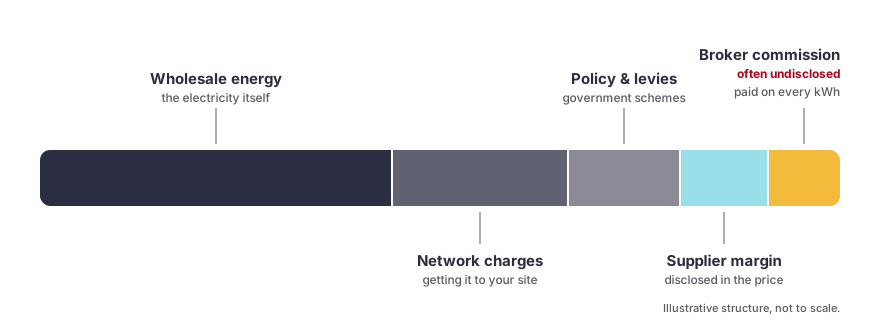
Three structural costs sit between you and the wholesale price:
- Undisclosed broker commission. Most brokers are paid by the supplier through an uplift on your unit rate. You pay it on every kWh, for the life of the contract, without seeing it.
- Mismatch between tariff and usage. A flat rate charged against a business that uses energy at predictable times pays for flexibility it never uses. The gap between how you are charged and how you consume is a real cost, invisible on the bill.
- Default rates. Deemed and out-of-contract rates apply when a contract lapses or a site changes hands. They are the most expensive way to buy energy in Britain and they persist because nobody is watching. See deemed rates and out-of-contract rates.
Independence you can build on
Until recently, the value in a business’s flexibility, shifting load or running a battery, belonged to its supplier by default. A market rule called P415, live since November 2024, changed that. An independent party can now take that flexibility to the wholesale market without the supplier’s involvement. The mechanics matter less than what they signal. The party managing your position no longer has to be the party selling you energy. Vester is paid by you, not by a supplier, so nothing in how we are paid pulls the advice towards a switch or a longer contract. Independence stops being a claim about character and becomes a fact about how the money moves.
The matching work is real
Getting the tariff right is not shopping harder; it is analysis. Half-hourly settlement means every large site’s consumption is priced against its actual profile. Matching that profile to the right structure requires your meter data, wholesale context, and independence from the supplier’s incentive. This is the work Vester charges for, openly.
Our disclosure, in full: Vester takes no commission, ever. We earn nothing from any supplier and nothing on the volume of energy you buy. Our revenue is the subscription you pay us directly, plus, on larger half-hourly sites, a disclosed tariff-matching fee. Market access costs 1p per kWh, and we pass it through at cost, keeping none of it. Where a partner introduces you, that partner earns a share of that access cost, disclosed to you to the same standard as our own fees.
Test your own position
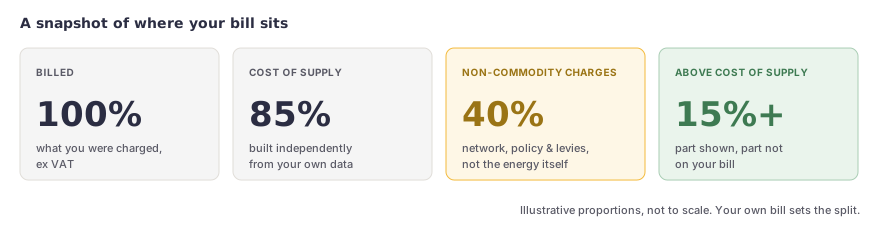
The way out of an opaque market is measurement. How to benchmark explains the method. If you would rather we ran it, request a benchmark of what you should be paying, or book a fixed-fee review.
The story you're told, and what the data says
The narrative
-
Your renewal quote is competitive. Sign before prices move.
-
The broker’s service is free.
-
A flat rate keeps things simple.
-
Everyone pays about the same.
The truth
-
A quote can only be judged against your own data. Urgency is a sales device.
-
Broker commission is added to your unit rate, and you pay it on every kWh.
-
A flat rate charges you for flexibility you may never use.
-
Identical businesses sign different rates on the same day, and neither ever knows.
How Vester is paid, in full, is on the pricing page.
In this section
Deemed rates: what they are and how to escape them
What deemed rates are, why suppliers can charge them, and the fastest way for a UK business to get off them.
Out-of-contract rates
Why out-of-contract rates exist, how they differ from deemed rates, and how to stop a lapsed contract quietly draining your budget.
How to benchmark your business energy costs
A method for testing whether your business energy costs are competitive, and why comparing unit rates alone will mislead you.
A quote is a sketch. The bill is the photograph. The gap is where cost and risk hide.
Frequently asked questions
How do I know if my business is overpaying for energy?
You cannot know from quotes alone, because commercial energy is a quote-only market: prices are not published and two identical businesses can be offered different rates on the same day. The only reliable test is a benchmark built from your own half-hourly data against wholesale prices and published network charges. If your effective unit rate cannot be explained by those components plus a disclosed margin, you are overpaying.
How do business energy brokers get paid?
Most brokers are paid a commission by the supplier, added to your unit rate for the life of the contract. It is rarely disclosed, and it rewards the broker for placing the deal, not for getting you the right price. Always ask a broker to state their commission in pence per kWh, in writing.
How can I reduce my business energy costs?
In order: check you are not on deemed or out-of-contract rates; benchmark your current unit rate against the market; match your tariff structure to when you actually use energy; then look at operational changes and on-site generation. Most businesses start at the wrong end, buying assets before fixing the tariff.
What is a disclosed fee, and why does it matter?
A disclosed fee is stated openly, in writing, before you commit. It matters because the alternative in this market is a commission buried in your unit rate that you pay on every kWh without seeing it. Vester takes no commission, ever, and earns nothing from any supplier. You pay us a disclosed fee directly: the subscription, and on larger half-hourly sites a named tariff-matching fee.