
Insights
Your Energy Tariff Is Really an Insurance Policy
What really drives your tariff and why smart organisations are choosing to self-insure.
Published Last updated
6 min readThe CFO was still staring at the renewal spreadsheet when I arrived. Three tariffs. Three very different prices. One supplier urged him to fix for two years. Another insisted a one-year deal would “take the winter risk off the table”. A third offered a time-of-use tariff with a cheerful note about “unlocking flexibility value”, which sounded to him like extra work.
He scrolled through the PDF and sighed.
“I honestly have no idea what I’m buying here.”
It was not a foolish comment. He wasn’t choosing a price. He was choosing a way of handling uncertainty. And uncertainty, in the electricity system, behaves a lot like a financial force of nature.
Most businesses think they are buying electricity. In reality, they are buying stability. And stability has a price.
The hidden system behind every tariff
Electricity is produced, transported and consumed almost in the same breath. National Grid ESO balances this constant flow. Weather, time of day and human behaviour nudge prices up or down. A still patch of air in the North Sea at 4.30 in the afternoon can send them climbing. A windy night in March can settle them again.
The UK runs several markets to cope with this turbulence. Tomorrow’s power is priced in the day-ahead auction. Today’s electricity trades within the hour. Beneath that sits the imbalance market, where reality finally declares itself. No single moment stands still.
A visual can make this clearer. Below is the most volatile wholesale day of winter 2024, measured hourly. The rhythm is unmistakable. Cheap at night. Expensive late afternoon. A tide rising and falling while most businesses sleep through it.
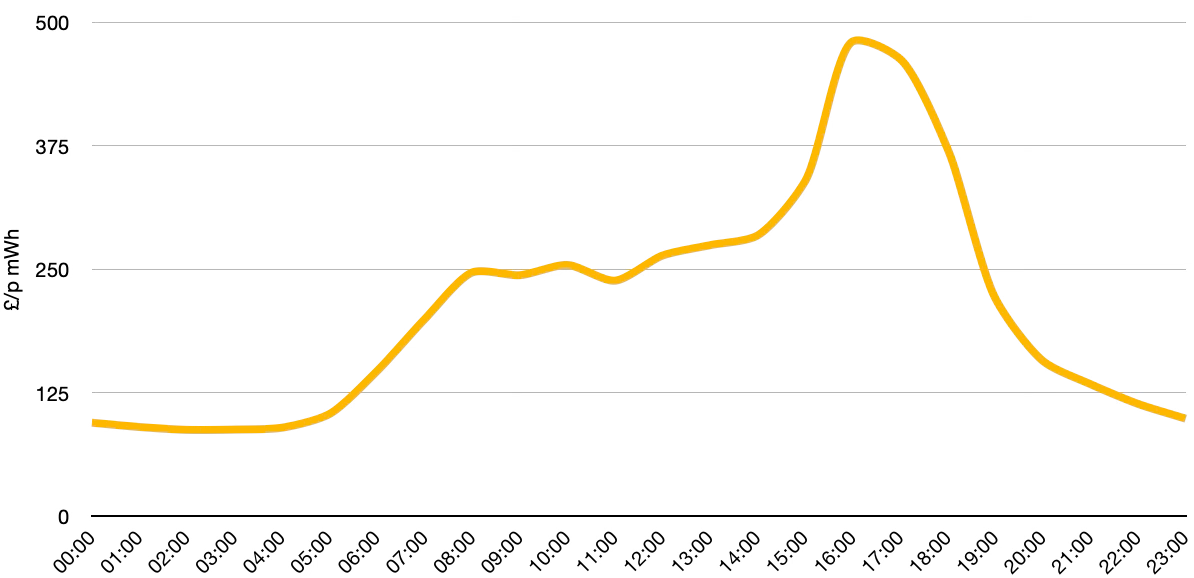
Suppliers know few organisations can follow such movement. So they place themselves between the market and the customer. They forecast how much their portfolio will use. They buy power ahead of time to secure a stable base. They adjust as forecasts sharpen. They pool risk across thousands of meters.
If this logic feels familiar, it should. It is the logic of insurance. Uncertain individual patterns, aggregated into something manageable.
A fixed tariff is not a statement about electricity. It is a price for predictability.
How suppliers package predictability
Behind every unit rate sits a chain of assumptions: expected wholesale cost, a buffer for volatility, hedging structure, operating overhead, supplier margin. On many days in a fixed tariff, the customer is paying for electricity that cost far less in the market. The difference is not inefficiency. It is the premium for avoiding the hours when prices might surge.
This is not criticism. Suppliers perform a valuable service for organisations that do not want to manage exposure themselves. But once you see the structure, the economic exchange becomes clearer.
The customer pays to avoid volatility.
The supplier earns a premium for absorbing it.
Some businesses benefit from that premium. Others, especially those with flexible assets, do not.
The tariff ladder: choosing your rung intentionally
Almost every tariff in the UK can be placed on a simple ladder.
Top: Fixed tariffs, where suppliers carry nearly all the risk and charge accordingly.
Middle: Day–night or red–amber–green structures, softening volatility into broad time bands.
Lower: Half-hourly pass-through tariffs, where the customer can respond to real market prices.
Bottom: Spot-indexed exposure, rarely offered to smaller organisations.
The higher you climb, the more certainty you pay for.
The lower you go, the more opportunity you create.
Most businesses land on a rung by habit rather than intention.
Why smart organisations often choose the wrong rung
This is not about capability. It is about confidence. Volatility feels uncomfortable. It complicates budgets. It invites awkward questions from boards. And the industry’s language, built for specialists, rarely helps decision-makers.
For years, I reached for fixed prices myself. It took time, data and many conversations to understand how risk moves through the system. Once you see the pattern, you see it everywhere.
This is where the insurance metaphor needs nuance. Insurance protects against rare catastrophes. Energy volatility is not catastrophic for most businesses. It is continuous and rhythmical. Uncertain in detail, predictable in pattern.
Yet the financial logic holds. Paying someone to manage a risk you could handle more efficiently yourself is still buying insurance you may not need.
When businesses quietly become energy traders
A business with solar, refrigeration that can shift cycles, EV chargers, controlled HVAC or a battery is no longer a passive consumer. It has timing. It has tools. It has leverage.
A battery charged overnight at 10p and discharged during the early evening at 35p is not gaming the system. It is responding to its signals exactly as designed.
Once assets can respond, the value of a fixed price shrinks quickly.
This shift is accelerating. Consider the rollout of smart meters, which unlock tariff structures that reward flexibility. 65% of the estimated 4m+ business electricity meters already support half-hourly reporting.
As smart meters become universal and half-hourly settlement reaches every customer, the economics of fixed tariffs will become progressively harder to justify.
A system moving toward responsiveness
Smart tariffs are spreading. Algorithms now optimise EV charging, refrigeration cycles and heat pump operation by the half hour. Commercial batteries are being installed specifically to arbitrage the spread between night and evening prices.
In each case, the business is no longer outsourcing volatility management to the supplier. It is insuring itself.
The future energy system will reward simple, reliable automation at the edge. Not sophisticated trading desks, but small decisions made consistently and quietly.
Where the metaphor ends
Suppliers are not insurers in the strict sense. They hedge imperfectly. They carry capital risk. They operate under political pressure. Many failed during the shocks of 2021 and 2022. Their models are more fragile than insurance firms.
But the structural parallel remains powerful. Suppliers carry volatility so customers do not have to. As technology shifts who can carry that volatility, the economics will shift with it.
Certainty will remain valuable. It will also remain the most expensive option.
The real question beneath every renewal
When a renewal package lands on a CFO’s desk, the right question is rarely “Is this a good price?”
It is “Which risks am I paying this supplier to absorb?”
If a business has no flexibility, the premium may be fair.
If it does have assets, automation or load that can move, the premium is often unnecessary.
Most organisations have never been shown that the choice exists.
Now they do.
Electricity is no longer just a bill. It is a behaviour. And the businesses that learn to move with the system, rather than stand apart from it, will quietly insure themselves.
As for that CFO, once we mapped the volatility he was paying to avoid, the picture sharpened.
He looked back at the spreadsheet with a different expression.
For the first time, he could see what he was actually buying.
If you found this in any way useful, consider subscribing for future essays on energy, risk and the new economics of flexibility.