
Network charges explained
What DUoS, TNUoS and balancing charges are, how they reach your business energy bill, and which of them you can still influence.
Last updated
Network charges pay for the physical system that delivers electricity: the regional distribution networks, the national transmission grid, and the constant balancing that keeps supply and demand matched. They are set through regulated methodologies rather than by suppliers, and they form a substantial part of every delivered unit price. Most businesses never see them, because most contracts fold them invisibly into a single rate.
That invisibility matters. Whether these charges appear as separate pass-through lines or disappear into a bundled rate is a contract structure decision, and it changes what you can manage. A cost you can see itemised is a cost you can question, forecast and, in parts, reduce. A cost averaged into a flat rate is just a bigger number.
The main components
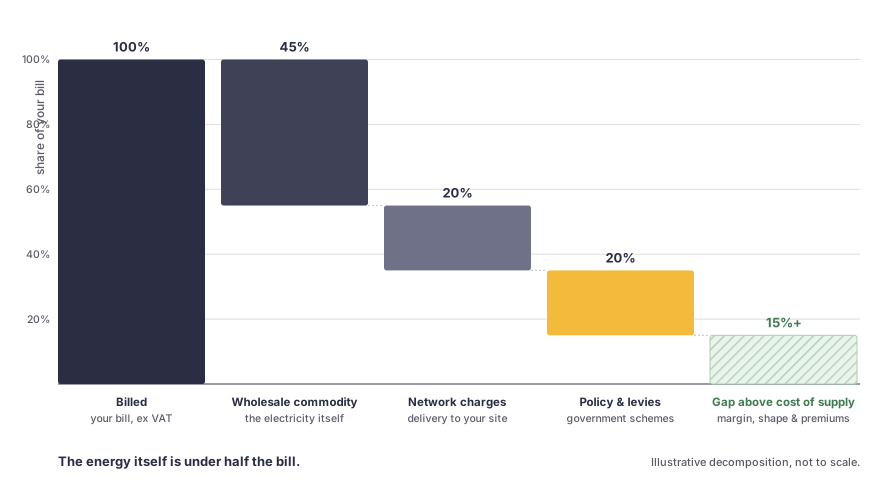
DUoS charges recover the cost of the regional distribution network and vary by region, connection voltage and time band, with the familiar red, amber and green periods pricing the daily peak steeply. TNUoS recovers the cost of the transmission system. BSUoS recovers the cost of balancing actions. Alongside the unit-based elements sit fixed and capacity charges, including the agreed capacity a half-hourly site holds with its network operator.
Take one month of a real, anonymised bill from a site on a fully unbundled pass-through contract, where every component is itemised rather than folded into a blended rate. The wholesale commodity came to about 7.86 p/kWh, the part most people assume is the whole story. Sitting alongside it, the DUoS capacity charge was billed at 9.26 p/kVA per day against 930 kVA of agreed capacity, a fixed cost that has nothing to do with how much energy was actually used that month. Then came the DUoS unit rates, priced by time band rather than as a single figure: 1.764 p/kWh in the red band, 0.205 p/kWh in amber, and 0.011 p/kWh in green, a spread wide enough that when you consume starts to matter more than how much you consume. On top of all that sat a further set of pass-through levies, BSUoS, CfD, RO, FiT and Capacity Market among them, each itemised on its own line rather than buried in a margin. Add it all up and the non-commodity components, network, capacity and levies together, came to roughly half the bill. Once you see it broken apart like this, “energy” stops looking like one number and starts looking like what it actually is: a stack of separately priced decisions, most of which have nothing to do with the wholesale market at all.
What changed with the Targeted Charging Review
The Targeted Charging Review moved the residual portion of network charges into fixed, banded charges. The old strategy of avoiding transmission charges by dodging Triad peaks no longer works for the residual element, which is now set by your band regardless of behaviour. What remains manageable are the forward-looking, time-banded elements and your capacity position. Advice that still leads with Triad avoidance is out of date, and it is worth noticing who is still giving it.
A banding review is worth doing wherever agreed capacity and actual demand have drifted apart. DUoS and Capacity Market charges are set against the capacity a site holds with its network operator, not the capacity it uses, so a site that has changed its operation since it was banded, downsized equipment, closed a process line, or was simply banded conservatively when it first connected, can carry years of fixed charges for headroom it no longer needs. The review itself is straightforward once half-hourly data exists: compare the maximum demand the site has actually recorded, ideally across a full year to capture seasonal peaks, against the agreed capacity on the bill. Where the gap is wide and consistent, reducing the agreed capacity lowers the fixed charge permanently. Where the gap is narrow, or driven by one unusual peak, a challenge is more likely to create risk than to remove cost, because breaching a reduced capacity later carries its own penalty. The review is only worth making when the data supports it, and that is precisely why it gets skipped: nobody looks at agreed capacity unless someone is already looking at half-hourly data for another reason.
What you can still do
Three levers survive scrutiny. First, structure: put network charges on pass-through so you can see them. Second, shape: shift consumption out of the expensive DUoS bands where your operation allows, which is also where batteries earn part of their keep. Third, capacity: compare your agreed capacity against your actual maximum demand from half-hourly data, and correct it where the two have drifted apart.
Network charges reward the managed and quietly tax the unmanaged. To see how much of your bill they represent and which levers apply to your sites, request a benchmark at /benchmark or book a review at /book.
Part of Commercial energy tariffs .
Frequently asked questions
What are network charges on a business energy bill?
They are the costs of the wires: Distribution Use of System (DUoS) charges for the regional network, Transmission Network Use of System (TNUoS) charges for the national grid, and balancing costs (BSUoS) for keeping the system stable. They are set through regulated methodologies, not by your supplier, and they make up a material share of the delivered price of electricity.
Can I reduce my network charges?
Some, yes. DUoS unit charges are time-banded, so shifting consumption out of the expensive bands reduces them directly. Capacity charges depend on your agreed capacity, which can be reviewed against your actual maximum demand. Other elements, particularly the fixed residual charges introduced by the Targeted Charging Review, are set by your banding and cannot be avoided by changing behaviour.
Why do my network charges differ from another site's?
Because DUoS rates vary by distribution region, by voltage of connection, and by time band, and residual charges vary by banding. Two identical businesses in different regions, or connected at different voltages, will pay different network costs for the same consumption. This is one reason a single national unit-rate comparison tells you very little.