
Insights
The market shift in business energy: half-hourly settlement, API tariffs and consent
Three UK reforms are reshaping how businesses buy energy: half-hourly settlement, API tariffs and consumer consent. What is changing, when, and what to do now.
Last updated
13 min readSign a long, locked-in business energy contract today and you have bought a liability. A lot is about to change in how electricity is priced and settled, and it is already changing. New tariff innovation is arriving, built on a digital shift in how the market measures and shares energy data that is already under way.
Three separate reforms sit behind it. They change how electricity is measured, how prices are published, and who holds the key to a site’s data. Each has its own delivery body and its own dates. They share an intent: energy data turns granular and standardised, tariff prices turn machine-readable, and permission to share data turns from a signed letter into a controllable digital object.
The first dated steps land in 2026 and 2027. The organisations that benefit first are the ones whose consumption data and tariff structure are already in order. This page sets out what is changing, when, and what it means for how a business buys energy over the next 18 to 24 months.
One caution before we set off. These are three distinct programmes, not one. They run in parallel and reinforce each other, but they are governed separately, and they are separate again from the work on broker and third-party intermediary regulation. Conflating them is how you end up planning for a market that does not exist yet.
What is actually changing
1. Every meter settled on real usage
Market-wide Half-Hourly Settlement (MHHS) is being delivered by Elexon. Every electricity supply point in Great Britain will be measured and settled in 30-minute intervals, rather than estimated against a generic load profile.
Large industrial and commercial sites already work this way, and MHHS doesn’t change them. What changes is everything below: smaller commercial supplies and domestic meters, which today settle on an assumed average shape. Under MHHS, a non-half-hourly business supply migrates over the transition window and starts settling on its real half-hourly record instead of a profile-class estimate.
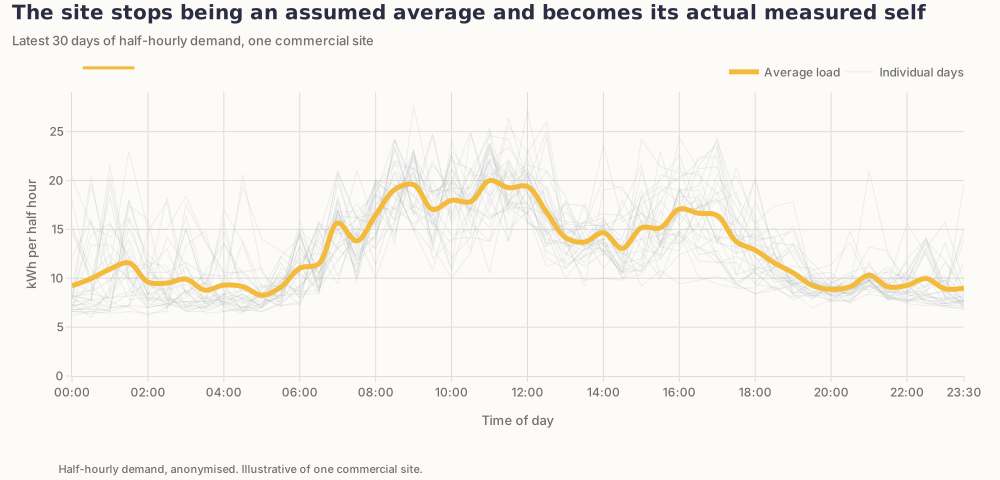
Here is why that reaches the buyer. When a supplier is settled against what a site actually used in each half hour, genuine time-of-use pricing becomes viable for smaller sites for the first time. The case for a battery, or for shifting load into cheaper periods, sharpens, because the value of that shift can be measured rather than assumed.
However, MHHS doesn’t change anyone’s tariff automatically. It clears the ground on which time-of-use products become meaningful, but the buyer still has to seek them out and choose them. The reform builds the road. It doesn’t drive the car.
2. Tariff prices published in a form machines can read
The second programme is tariff interoperability, run by DESNZ and RECCo through the Retail Energy Code and supplier licence conditions, delivered under the Smart Secure Electricity Systems work. The obligation falls on electricity suppliers: publish tariff pricing data in a standardised, machine-readable form through APIs.
The purpose is consumer-led flexibility. Publish a price in a standard format and optimisation services, smart appliances, EV chargers, heat pumps and batteries can respond to it. The mandate concentrates on residential use first. The 18 February 2027 obligation is broad, though: it exempts only certain non-domestic suppliers, not business tariffs as a class.
So the mandate is not the whole market, and some suppliers are already ahead of it. Octopus Energy has sold Shape Shifters: Agile, a half-hourly, API-accessible tariff for small businesses, since January 2025, marketed as the first fully agile tariff for small businesses in the UK. That is one supplier, not the field. It shows a business that understands where this is heading can be rewarded now, not only in 2027.
People describe this as the end of the price book. As a claim about where the market is heading, that is defensible. As a dated event, it is not. The first dated step away from the closed, opaque price book is the 18 February 2027 target for public tariff pricing data. A real step, not the whole journey.
3. Consent as a controllable object, not a signed letter
The third programme is the Consumer Consent Solution, delivered by RECCo, appointed by Ofgem in April 2025, as part of the Retail Energy Code and aligned to the Data Use and Access Act 2025.
It is a standardised, secure, central framework that lets a person grant, review, renew and revoke consent to share their energy data with a trusted third party. Access is permitted only for the stated purpose. Onward sharing is a breach that removes the offending party from the Trust Framework. The consumer can revoke at any time, and RECCo is responsible for central identity verification.
The scope here needs to be exact. The first release is domestic only. Non-domestic supplies, including microbusiness, are explicitly out of scope for the first marketable version, treated as permission-led rather than consent-led, and held as a future-roadmap consideration. So this framework does not yet govern business energy consent. The token model is being built for households first.
That distinction matters, because of what the token replaces.
Why the consent token matters more than it looks
Today, a broker’s access to a site’s data rests on a Letter of Authority. It’s signed on paper or electronically, it usually runs for around 12 months, it grants broad standing access, and it has to be re-signed to renew.
A grant-and-revoke consent token is a different object. It’s narrower. It’s controlled by the customer. It’s scoped to a stated purpose. It can be revoked without a counter-signature. Where a model like that reaches a market, it undermines the broad, long-dated Letter of Authority and the friction of getting it re-signed. Any approach built entirely on phone contact and manual re-signing is the most exposed to the change.
This lands on households first, because the first release is domestic. The read-across to non-domestic is not a live fact yet. But the design principle, consent as a scoped and revocable token rather than a broad and durable authority, is now being built into the plumbing of the market.
The business Letter of Authority sits in a separate reform track, and that track is now moving. Ofgem is being appointed regulator of third-party intermediaries, the energy brokers, following a DESNZ consultation and the government’s 2025 response. It has opened a market review, a Call for Input published on 4 June 2026 and closing on 16 July 2026, that covers non-domestic as well as domestic brokers. The review does not name Letters of Authority as a scoped item. It does examine how brokers get permission to act on a customer’s behalf, and where that goes wrong, which is the same ground any LoA reform would cover. Whether that becomes a specific rule change depends on Ofgem’s findings, due winter 2026/27, and a further consultation after that. So the unsatisfactory LoA mechanics are in sight, if not yet in scope.
There’s also a proposed accreditation angle worth naming carefully. Cyber Essentials Plus is under discussion for the accredited third parties that use the consent framework to access data, not for every broker in the market. It’s proposed, not confirmed, and its scope is specific. Treat it as a signal of where standards are heading, not a rule that already applies.
The estimate at the heart of a business quote
To see why measured data is such a change, look at the number every non-half-hourly business quote starts from: the estimated annual consumption, or EAC.
An EAC is a single estimated annual usage figure, paired with a generic load profile. It drives the unit rate, the standing charge and the commission built into a quote. And it’s unreliable, often extrapolated from thin data. It captures volume but not shape. Two sites with the same annual total can cost very differently once you look at when they actually use power. This is why so many business energy quotes break down on contact with a real bill. MHHS closes the gap by replacing the estimate with the site’s measured record.
One site we’ve analysed shows the size of that gap. It’s a refrigeration-led agricultural operation, and their real half-hourly load costs about 8p per kWh at wholesale, against the roughly 13p commodity rate written into their flat contract. The flat rate charges them for an average shape they don’t have. Move that single meter onto a transparent day-ahead tariff that passes the wholesale price through, and the saving is about £25,000 a year, no capital required, roughly 12% of the electricity bill across the wider portfolio. Nothing physical changes on the site. The price simply starts to follow the measured usage instead of the estimate.
The EAC breaks in a specific way once a site adds solar. An EAC describes gross consumption. After solar, the meter sees net import: gross demand minus the on-site solar used behind the meter. A pre-solar EAC therefore overstates future grid import, and it does so unevenly, because solar generation is concentrated in daylight hours and in summer. A quote priced off a pre-solar EAC misreads both the volume of import and its shape.
The practical rule follows directly. Price off measured half-hourly data, and get your consumption data in order before you add generation. Adding solar to a site whose baseline is a guess means compounding one estimate with another.
A note on the profile classes underneath all this. The codes matter less than what they mean for you. A standard non-domestic single-rate supply sits in profile class 03, a two-rate supply in profile class 04. On migration to MHHS, most non-half-hourly supplies stop being settled on that profile-class shape: the measurement class changes to half-hourly, the profile class becomes 00, and settlement follows the meter’s actual half-hourly record instead of an assumed average. A subset on older meters with switched load is shaped differently, but the principle holds. The point for a buyer isn’t the code. It’s that the site stops being an assumed average and becomes its actual measured self. That measured record increasingly exists through Elexon’s Smart Data Repository, with the consent framework as the layer that records whether access to it is permitted.
What changes, and when
These timelines have already moved, twice. MHHS was first due to complete in October 2025, in Ofgem’s 2021 Full Business Case. Two Ofgem-approved replans pushed it back: CR022 in June 2023 extended the migration window from 12 to 18 months, and CR055 on 29 November 2024 added around a further six and a half months. Migration is now not due to finish until May 2027, with cutover in July 2027. That is roughly 20 months of slippage across two approved replans. Treat every future date below as a target, not a promise, and note which are confirmed and which are not.
| Date | What happens | Programme | Status |
|---|---|---|---|
| Sep 2025 | Central systems go live (Milestone 10) | MHHS | Confirmed, delivered |
| 22 Oct 2025 | Supplier migrations begin | MHHS | Confirmed, delivered |
| wk 16 Feb 2026 | Programme exits Early Life Support, agreed by the Migration & Cutover Advisory Group on 12 February; Elexon announced it and the 2 million meters migrated on 16 February | MHHS | Confirmed, delivered |
| 13-14 May 2026 | Government response on tariff interoperability published; phasing set | Tariff interoperability | Confirmed, delivered |
| 18 May 2026 | REC Schedule 35 and licence condition introduced | Tariff interoperability | Confirmed, delivered |
| ~Oct 2026 | Around 80% of meters targeted for migration (Milestone 14, 28 Oct 2026) | MHHS | Target |
| Q1 2027 | Consent framework Minimum Marketable Product, domestic only, supporting half-hourly metered data | Consumer Consent Solution | Target |
| 18 Feb 2027 | Public tariff pricing data go-live (Phase 1a) | Tariff interoperability | Target |
| 7 May 2027 | Full MHHS implementation (Milestone 15) | MHHS | Target, scheduled |
| 2 July 2027 | Cutover to shortened settlement (Milestone 16) | MHHS | Target, scheduled |
| Nov 2027 | Consumer-specific tariff information (Phase 1b) | Tariff interoperability | Planned, not settled; further consultation expected later in 2026 |
The confirmed part is short. MHHS is live and migrating, with around 80% of meters targeted by roughly October 2026 and full implementation scheduled for May 2027. Suppliers face an obligation to publish standardised, machine-readable public tariff data, first targeted for 18 February 2027. A consumer consent framework with grant-and-revoke tokens reaches its first marketable version in Q1 2027, domestic first.
What it means for how a business buys energy
Put the three together and the picture is clear enough to act on, without overstating the case.
As real half-hourly data replaces estimates, the gap between the quote and the bill narrows, and pricing moves towards measured usage. That reduces the market opacity that lets overcharging persist. The market becomes more visible, and making that visibility usable is the work.
Standardised tariff data makes time-of-use pricing easier to compare and easier to act on. The residential and flexibility use cases lead here, so for a business the mandated version is still ahead. But the mismatch between how a site uses energy and how it’s charged becomes addressable in a way it wasn’t before.
The consent token narrows and formalises data access, and over time it undermines the broad Letter of Authority. Households feel this first.
There is a practical limit, and it governs what you should do. Waiting on a centrally mandated technical change is not a strategy. Government has a poor record of making an industry move quickly, and every one of these programmes has already slipped. The confirmed near-term dates are aimed at households first. Business follows.
But the reform arrives at the market before it arrives at your meter, and forward-thinking suppliers are already testing and launching business products that use these changes, Octopus among them. By no means all of them, or even many. A business that understands where this is heading, and understands its own load, can be rewarded now. So get your consumption data and tariff structure in order. Then you can act on the first day the right product reaches you, rather than starting from a standing position.
For a finance lead, the line to carry internally is this: the value is in getting our consumption data and tariff structure in order before the market reprices around real usage, so we are ready to act on the first day the products reach us rather than starting from a standing position.
The businesses that read the road early are the ones already moving when the rest are still waiting for the sign.
Related reading
- Commercial energy tariffs, why most sites are charged in a way that does not match how they use energy
- Network charges explained, the components beneath the unit rate
- Commercial solar and battery, how measured data changes the investment case
- Your Energy Tariff Is Really an Insurance Policy
Sources
- Ofgem, MHHS change request CR055 decision, 29 November 2024: https://www.ofgem.gov.uk/decision/market-wide-half-hourly-settlement-change-request-cr055-amendments-m10-and-corresponding-milestones-decision
- MHHS Programme, key programme milestones (covers the 2021 Full Business Case baseline and the CR022 replan): https://www.mhhsprogramme.co.uk/programme-information/key-programme-milestones
- Elexon, Market-wide Half Hourly Settlement and the BSC: https://www.elexon.co.uk/bsc/operational/market-wide-half-hourly-settlement/
- RECCo, Tariff Interoperability Project: https://retailenergycode.co.uk/our-programmes/tariff-interoperability-project/
- Gov.uk (DESNZ), Tariff interoperability consultation outcome: https://www.gov.uk/government/consultations/tariff-interoperability
- Ofgem, Consumer Consent decision, 29 April 2025: https://www.ofgem.gov.uk/sites/default/files/2025-04/Consumer_Consent_Decision.pdf
- Ofgem, Third-party intermediaries (TPIs) market review, Call for Input, 4 June 2026: https://www.ofgem.gov.uk/call-for-input/third-party-intermediaries-tpis-market-review
- Gov.uk (DESNZ), Regulating third-party intermediaries in the retail energy market, government response: https://www.gov.uk/government/consultations/regulating-third-party-intermediaries-tpis-in-the-retail-energy-market/outcome/regulating-third-party-intermediaries-tpis-in-the-retail-energy-market-government-response-accessible-webpage
- Octopus Energy, Shape Shifters: Agile: https://octopus.energy/smart/shape-shifters/
- Octopus Energy, press release on the launch: https://octopus.energy/press/more-news-press-releases/shift-and-save-octopus-launches-the-uks-first-agile-tariff-for-small-businesses/